
The Holy Trinity
- Understand the broad historical context of the early Christian Church as it leads up to the establishment of the doctrine of the Trinity.
- Gain a better understanding of the theological ideas contained in the accepted concept of the Trinity.
- Gain an appreciation of competing theology, and why those ideas were argued against with zeal.
The doctrine of the Trinity is central to Christianity. It holds that one completely divine God exists in three persons, the Father, the Son, and the Holy Spirit, who are distinct yet consist of the same essence or substance. They are distinct from each other in their relations to one another and in the way they relate to creation. All things are from the Father, through the Son, and in the Holy Spirit.
Summary of Historical Christianity leading to the Trinitarian Controversy
-
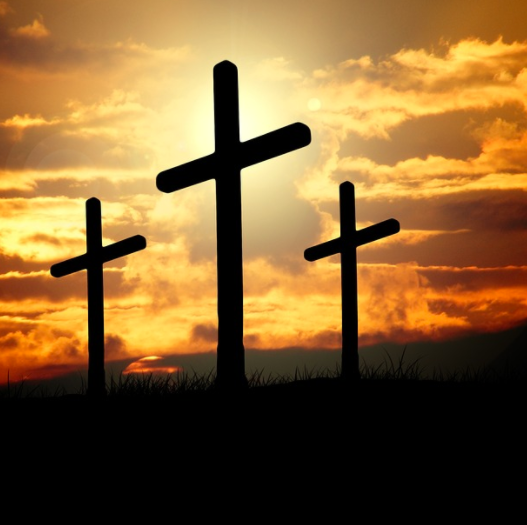
Life of Jesus
~4BCE - 30CE
Jesus Christ lived, beginning his ministry around age 30, was crucified, and as Christians believe, was resurrected 3 days later.
-
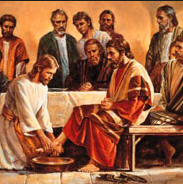
Apostolic Age
33 CE-100 CE
Christianity immediately began to spread through the Roman Empire and beyond through the Twelve Apostles, other followers of Jesus, and those they recruited. For about a generation, Christian belief was transmitted orally. Beginning around 65 CE, the Gospels were recorded. Oral traditions and rituals continued to be established. As Christianity gained in popularity, it began to face opposition from the surrounding Jewish and Greco-Roman culture.
-
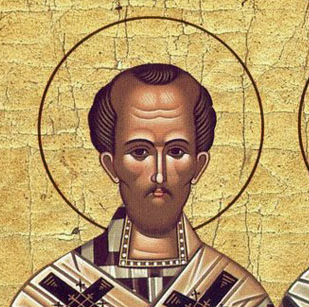
The Patristic Period
~100 CE - 400 CE
The theologians who had direct contact with the Apostles are referred to nowadays as the Apostolic Fathers. Tradition continued to be established, but the writings of the Apostolic Fathers did not find their way into the New Testament. During this time, Christianity faced increasing persecution. Prominent Christians were martyred. Christianity began to distinguish itself more from Judaism and struggles to define itself theologically.
-
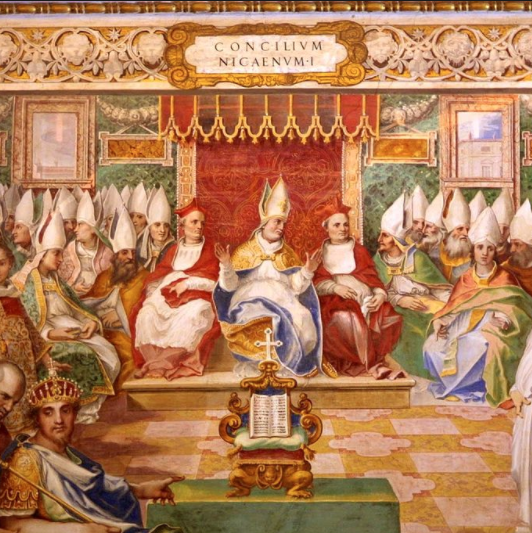
The Council of Nicea
325 CE
The Council of Nicaea confirms that the Son of the Trinity is equal in substance to the Father. The Son is truly, fully God.
-
Council of Constantinople
381 CE
The Holy Spirit was confirmed as equal to the Father and the Son.
Theological Development of the Trinity in Early Christianity
Apostolic Age
- Christianity developed out of Judaism and in contrast to existing Judaic and Greco-Roman belief. Despite this, it is believed that Jesus Christ was worshipped during even very early Christianity. How then, is Christ to be viewed in relation to God?
- Paul referred to God, Jesus and the Holy Spirit at the same time, and his words provide some of the first hints for the concept of the Trinity, though it was not referred to as such.
- Despite the seemingly pressing question, at the time of Jesus many Jews believed in an apocalyptic expectation - the belief that God's intervention in humanity was imminent. They saw Jesus as the fulfillment of this expectation, and lived their lives as if the end of the world was approaching. A complex theology was not initially established, though early oral and written traditions were used to support later arguments.
The Patristic Period
- Early Christian theologians continued to reference the Father, Son, and Holy Spirit often,
Some of the earliest recorded references come from the early martyrs Ignatius of Antioch and Justin Martyr. - The church begins to attribute a divine nature to Jesus and call him God, even though he was not considered on the same level as the Father.
- During this time, various debates about the nature of Christ and God began. Several theories were discarded by the Church:
- Adoptionism - Jesus was an ordinary man who became Christ by being baptized.
- Sabellianism/Modalism - All parts of the Trinity are actually one in the same, and the difference is only perceived by humans. God wears three different "masks".
- Logos Theology/Subordinationism - The early Christian thinkers Origen and Justin Martyr espoused a hierarchy - the Father was superior to every other existing being, the Son is second only to the Father and is seen as the Logos - the divine Word of God, and the Holy Spirit is second only to the Son and Father.
- However, the idea of three equal "persons" in God was not established.
- These discussions were more concerned with the nature of the Son than of the Holy Spirit.
The Arian Controversy
- As the discussions and debates about the nature of Christ and the Holy Spirit continued to wage on and become more complex, they came to a head in what is known as the Arian Controversy.
- Arius, a presbyter (elder) in the church believed and was teaching, in line with subordinism, that the Son was a creature who was created some time after God, is distinct from God the Father, and therefore subordinate.
- Arius' superior, the bishop Alexander disagreed that the Father could preexist the Son and excommunicated him.
- The matter was far from settled in the church, and attempts for each side to "win" involved political maneuverings with the emporor.
- The Council of Nicaea was called in 325 CE specifically to address the Arian controversy. It declared that the Father and the Son were of the same substance or essence. The Son was not created by the father, but was begotten by him.
- What does this mean? Something created is not of the same type as it's creator. God the Father creates man, but man is not God. However, something begotten is of the same type. God the Father created the Son, and the Son is God.
- To eliminate dissent and unify the church, the Council created the Nicean Creed as a formal statement of the agreed upon decisions at the council.
- The debate continued to wage between the competing factions for decades.
- The Council of Constantinople was called in 381 CE and declared the Holy Spirit to be on the same level as the Son and the Father, releasing a modified version of Nicene creed.
Food for Thought
-
The early church fathers believed that a correct understanding of God was crucial to our salvation. They believed that humanity would be saved by becoming divine. The Father sent the Son to earth to divinize humanity. The Holy Spirit is seen as the part of the Trinity that can effect this in humans, as it acts to sanctify them. With that in mind, can we consider why it was important to those involved in the debate that the Holy Spirit, the Son, and the Father be seen as equal?
-
No Old Testament or New Testament verses directly reference the Trinity. Christian theologians have argued that Trinitarian concepts can, however, be inferred from scripture.
However, there are large religious bodies today that do not adhere to the described Trinitarian but consider themselves Christians, such as Mormons and Jehovah's Witnesses. How should we think about and respond to them today?
-
Despite some rather precise seeming definitions and exclusions, it is generally agreed and even celebrated that just as the nature of God is an unknowable mystery to mortals, so is the nature of the Trinity. Considering that, does this change what we have just discussed? If you are like me, you may have had heard or remembered little prior discussion of the Trinitarian doctrine at church. Sure, we sing about it in hymns and confirm it with our creeds, but it is often not rigorously examined, and as we have discussed not even agreed about. Ought we to place more importance on it? Consider the following from a longer and interesting article about the Trinity:
“Trinitarian theology, in so far as it is concerned with what ‘kind’ of God Christians worship, is far from being a luxury indulged in solely by remote and ineffectual dons; it is of cardinal importance for spirituality and liturgy, for ethics, for the whole of Christian self-understanding.” (Rowan Williams, Wrestling with Angels: Conversations in Modern Theology, p. 142)
Introduction
Jesus and the Incarnation
However, there are large religious bodies today that do not adhere to the described Trinitarian but consider themselves Christians, such as Mormons and Jehovah's Witnesses. How should we think about and respond to them today?
“Trinitarian theology, in so far as it is concerned with what ‘kind’ of God Christians worship, is far from being a luxury indulged in solely by remote and ineffectual dons; it is of cardinal importance for spirituality and liturgy, for ethics, for the whole of Christian self-understanding.” (Rowan Williams, Wrestling with Angels: Conversations in Modern Theology, p. 142)